Book Review: Maintenance of Everything (Part One)
7 April 2026
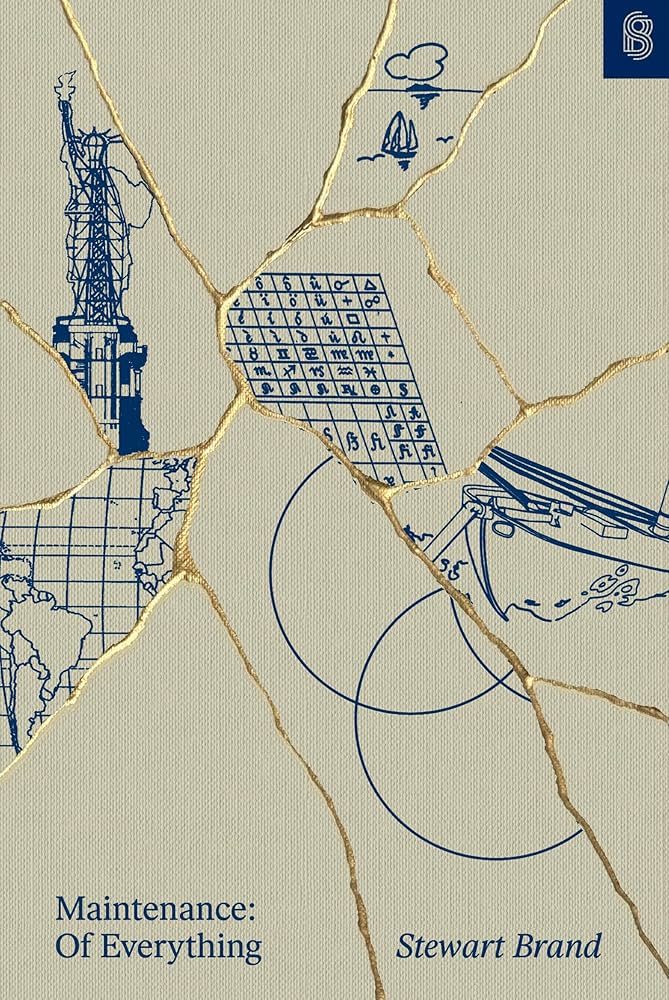
I finished this book about 3 days after Stubborn Attachments. I place it in the "How To Do Things" category of Stripe Press books, which seems to be the category receiving the most recent additions. In a contrast to the fairly early (2019) SA, MoE was mostly a wandering but intentional path through various examples related to the central thesis, which, in combination with engaging images, made for a fun read.
This is not the first time Stewart Brand appears in a Stripe Press book: that honor belongs to The Dream Machine, in which his favorable review (in Whole Earth Catalog) of Spacewar and other interactive computing on the Alto gets a shout. It'll be a nice edge in the graph when I finally get around to making my summary posts!
What's the central thesis of MoE? Well, it's that maintenance is good, I guess. Specifically, a holistic view of maintenance, including preventative maintenance, designing for easy maintenance, entering the maintenance frame of mind, creating a culture of maintenance, and so on. Brand also explicitly states he intends to start with small objects like weapons and vehicles, and slowly zoom out to a societal level of maintenance. It's a rather boringly defensible thesis, but perhaps that just speaks to the book's ability to drive one central important point home (more than most books accomplish on their readers!). I don't mind though: I think it's clear that much of what readers are supposed to take away from Stripe Press books is meant to either be so obvious (often the "how to do things" category) or so subtle (many of the "histories" category) that either way it percolates into the subconscious. Meanwhile the other two categories sit squarely in the conscious, but for two very different reasons: the "stagnation" books for asking the central question "what happened in 1970?" and the "how to run an organization" books for specific tactical answers like "this is what an interview rubric should look like."
Two books MoE is quite connected to are Potter's The Origins of Efficiency and Eghbal's Building in Public. On the first, Ford's advancements in manufacturing, along with prior improvements in precision and tolerances, feature prominently in MoE, providing another angle on what made the Model T so successful. On the second, discussion on the psychology of users vs contributors vs maintainers had parallels to the concept of sustainment in war, and I'm sure, as Brand explicitly mentioned, software maintainence will appear in MoE Part 2.
Also, this book played with the paper format perhaps more than any other book in Stripe Press's catalogue. Lots of images, comments from early reviewers in the margins, mostly third-person with some first-person dipping in. And the Kintsugi cover.
And now, the summary.
- Introduction: some nice signposting by Brand about the books contents.
- Chapter 1: Golden Globe around-the-world solo boat race. Three philosophies on maintenance: Knox-Johnson with constant maintenance and a diligent mind; Crowhurst with his magical thinking, neglectful mindset, and ultimate demise; and Moitessier with his preventative maintenance and prepared mindset. Knox-Johnson won, Crowhurst died, and Moitessier could've won, but left the rat race instead.
- Chapter 2.1: Two motorcycle maintenance philosphy books: Crawford's 2009 Shop Class book and Pirsig's 1970s Zen book. Crawford's methodical approach of finding then solving; Pirsig's seven gumption traps. 2.1a (motorcycle organ donation) and 2.1b (disassembly as mastery).
- Chapter 2.2: Three car maintenance philosophies. Early electric cars with low maintenance and low performance, Rolls Royces with no maintenance and low mfg volume, and Model Ts with high performance and high but flexible maintenance.
- Chapter 2.3 (a "Digression"): Rise of precision and interchangeable parts. Wilkinson's smooth-bore cannons. French Gribeauval system of interchangeable parts. End of Gribeauval via Rosseau. Tousard cross-pollination to US. Harper's Ferry armory and Blanchard lathes (creates a perfect copy using a master reference). Easy maintenance and interchangeable parts on John Hall's breech-loading rifle. Use of gauges, encouragement by war department to share and transfer expertise (esp. under Bomford), mechanization. Colt revolver success via marketing despite lack of true interchangeable parts. Singer looms similar to Colt. Bicycle craze enabled by precise machines and Pope's early mass production. Universal milling machine and turret lathe, and steel stamping. Ford's improved mass production and use of Jo Blocks. Decrease in tolerances all the way through ARPA, missiles, semiconductors.
- Chapter 2.4: 3 most popular cars and easy maintenance (already talked about Model T). The russian Lada: simple, cheap, comes with maintenance tools. Volkswagen vans: "How to keep your Volkswagen Alive" manual by hippie John Muir; emphasis on preventative maintenance.
- Chapter 2.5a (digression): 6 great manuals of history. Two types of manuals: shop manual from manufacturer, and third-party manual that's more user-centric. Best manuals include point-of-view photos. 1: Model T service manual. 2: Diderot's encyclopedie. Cut across class lines, elevated "artisans", crushed by french revolution but inherited by scottish enlightenment. 3: Culpeper's Directory for Midwives. 4: Moxon's Machnick Exercises. Early efficiency ideas. 5: I.33. Self-defense using reductive analysis. 6: Swiss Environmental Action Foundation's Dry Stone Walls.
- Chapter 2.5b: AK47 vs M16. AK47 was cheap, had few parts, easy maintenance/disassembly, and even cleaned themselves when fired. While M16 had superior performance under ideal conditions, they jammed easily and were a nightmare to clean/repair/maintain. This killed many american soldiers in Vietnam. Cartoonist Will Eisner illustrated a repair manual that encouraged preventative maintenance and avoiding complex tasks. Design history of both weapons: M16 selected by out-of-touch bureaucrats vs Kalishnikov's firsthand experience. AK47 is vastly more common in the present day. 2.5c footnote: sappy photo.
- Chapter 2.5d: youtube has replaced the physical manual. Specificity of advice due to huge catalog and search feature. Use by car enthusiasts and surgeons. Neat rabbitholes like fractal vise. Optimizing for virality.
- Chapter 2.6 (digression): Rust. rusting cars, 12 types of rust. Rust process (oxygen binds to iron molecules, forms larger molecule, surface flakes off. Primary defense: paint (submarine paint ode). Next defense: galvanized steel, with magic ingredient of Zinc. Final best solution: stainless steel. Rusting of Statue of Liberty. Maintenance stopgaps used until complex 1986 overhaul (hard deadline of 100-year anniversary of the statue).
- Chapter 2.7 (digression): sustainment. October War against Israel. Egypt and Syria have initial success, but lose the war due to not maintaining their vehicles. In fact, Israel captures and repurposes many of the tanks Egyptians leave behind. This relates to cultural differences: arabs defer to authority, hide mistakes, expertise is hoarded, maintenance is considered menial, and leadership is disconnected from infantry. Israelis are self-starters, leadership empowers individuals to make their own decisions, expertise is shared, maintainers are respected. Geopolitical takeaways were interesting: Egypt celebrated the start of the war and learned nothing; Israel was startled, took the wrong lesson and voted out their Labor government and became more polarized.
- Chapter 2.7b: American concept of sustainment. Mission command vs detailed command. Mission command in the form of Napoleon's corps system (autonomous underlings). The defeated germans took this lesson to heart and became the Nazis! Holistic maintenance as part of sustainment. Iterative learning and systems thinking as part of sustainment.
- Chapter 2.7c: Ukraine's use of maintenance in 2022 russian invasion. After shock of 2014 invasion, Ukraine adopts maintenance mindset. Corruption (leading to poorly maintained vehicles) and mud causes Russian run for Kyiv to fail. Zaluzhnyi follows NATOs mission command. Uses NCOs liberally (NCOs are bridge between officers and enlisted). Heavily resourceful Ukrainian maintainers. Starlink and strong tech sector supporting Ukraines goals. Labor intensiveness of maintainence means it's usually low-status entry-level work.
- Chapter 2.8: revenge of electric vehicles, via 2012 Tesla Model S.
- Chapter 2.9 (digression): Elon Musk's "the algorithm" efficiency in manufacturing process (removing steps, simplifying, speeding up, mechanizing, in that order).
- Chaper 2.8 contd: electric cars and fewer parts via mega-casting. ebikes and battery share.
- Chapter 2.10: unreliability of english cars due to Lucas Industries electrical parts.
- Chapter 2.11: horses as the first vehicle, and only one that "cares back"
I have simpler takeaways here. Patiently waiting for part 2...
- Multiplication of maintenance costs further down the chain: design out maintenance, then perform preventative maintenance, then do regular repairs, then comes catastrophic fixes. Each is a 10x larger nuisance than the previous.
- Mindset. have the realistic, maintainers mind, rather than the neglectful mind. It's easy, with how much maintainence is optimized out of our life in favor of simply replacing an item, to become a passive consumer in all domains. This can lead to the wrong attitude in the most important domains: large purchases, our career, our health, our civilization. Maintainence always comes due.
I'm on the last Stripe Press book, the first one, High Growth Handbook right now, and hoping to finish my review backlog around when I finish that book, and both by the end of April. We'll see if that happens.